Light is both the means of seeing a work and one of the conditions that can change it. A private gallery therefore needs more than a choice between warm and cool lamps. It needs a coordinated account of daylight, electric light, surface reflection, operating hours and the sensitivity of the objects being displayed. The most convincing atmosphere is one that can be maintained without relying on constant improvisation.
Start by separating two questions. What does a viewer need in order to understand the work comfortably? What exposure can that particular object tolerate? Those answers should be developed together by the relevant project specialists. A dramatic rendering may describe an intended mood, but it cannot establish the suitability of an installation for a collection.
Read daylight as a moving condition
A bright room photographed at one hour tells little about its behaviour across a year. Record orientation, surrounding buildings, reflected sunlight and the depth of window reveals. Think about the path of a direct sun patch, not only the average brightness of the space. A work that appears safely outside the light in spring may be affected under a different seasonal sun angle.
The Kimbell Art Museum in Fort Worth and the Nasher Sculpture Center in Dallas offer distinct references for the architectural management of daylight. Their strategies belong to their own buildings, climates and collections. The useful lesson for a private room is the need to coordinate roof or window geometry, filtering, maintenance access and supplementary light rather than treating them as separate decorative choices.
Locate reflections before selecting fittings
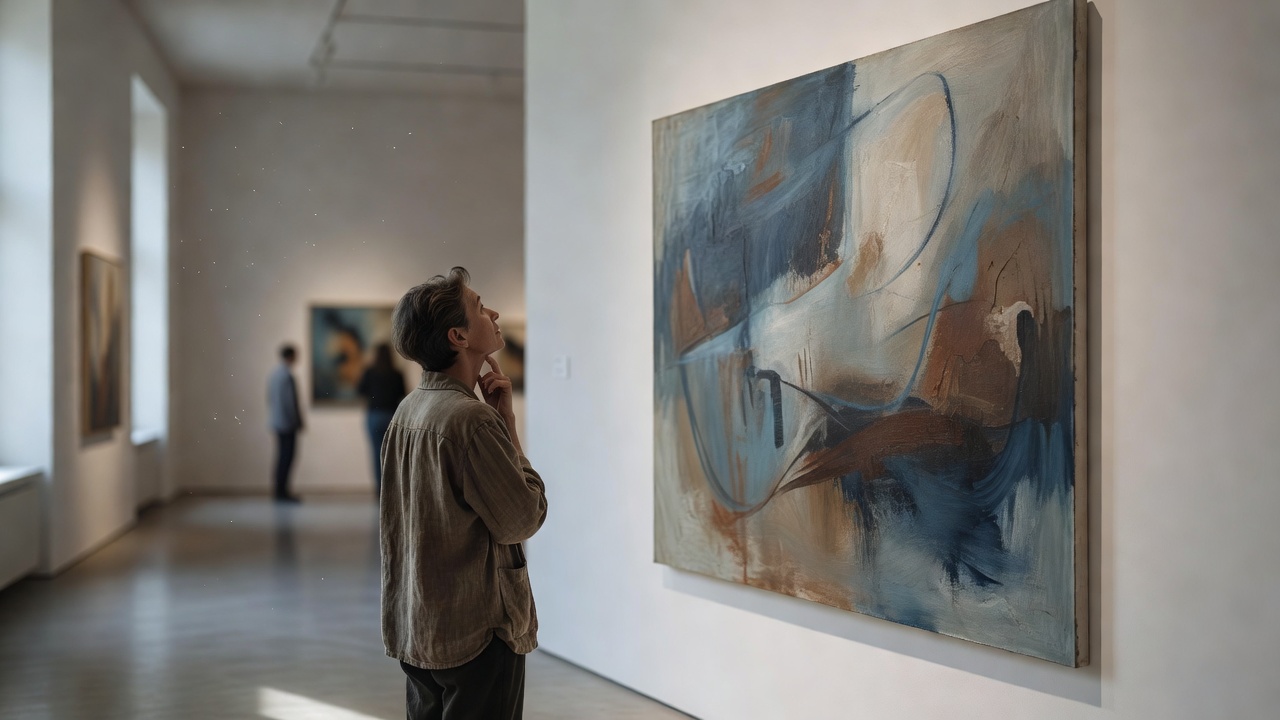
Glazed works are useful diagnostic surfaces. Stand at the expected viewing position and consider which windows, lamps and bright walls will appear in the glass. Moving a luminaire may help, but a reflection can also be caused by the architecture behind the viewer. Test a representative frame or sample glazing early, at more than one eye level.
Sculpture poses different questions. Modelling light may reveal form, while excessive contrast can hide a surface or create distracting shadows. Moving-image work may need a separate adaptation zone so that a visitor does not arrive from a bright room unable to see the screen. Treat these differences as part of the display sequence rather than asking one universal lighting scene to solve everything.
Compare systems by what they permit
| Approach | Useful quality | Issue to test |
|---|---|---|
| Controlled daylight | A changing relationship with the outside | Direct sun, seasonal exposure and reliable shading |
| Adjustable track | Re-aiming for different arrangements | Glare, beam overlap and safe access |
| Wall washing | A relatively continuous illuminated surface | Uniformity, room brightness and frame shadows |
| Integrated case lighting | Local control for enclosed objects | Heat, reflections, servicing and material compatibility |
Product data is a starting point, not a substitute for a mock-up. Ask a lighting designer to demonstrate the proposed fittings on representative colours, textures and frames. Dimming performance, colour consistency and the behaviour of the beam at low output may be more revealing in person than a single headline specification. Check that the controls remain understandable to whoever uses the room daily.
Make exposure a recorded decision
Illuminance describes light at a surface; cumulative exposure also depends on how long that light is present. Neither a low setting nor a modern LED source makes every object safe by default. Material sensitivity, previous condition and the spectral characteristics of the source all require attention. The Canadian Conservation Institute and CIE 157, Control of Damage to Museum Objects by Optical Radiation, are useful starting references for specialist discussion.
Do not copy a numerical target from an unrelated collection. Ask a qualified conservator to identify appropriate limits, monitoring methods and any display rotations. Then translate those decisions into usable settings: a viewing scene, an unoccupied state and a dependable way to control daylight. Include the person responsible for opening and closing the room in that conversation.
Leave room for adjustment
A lighting plan should anticipate the next arrangement. Record fitting locations, aiming notes and control settings, and retain the information needed to replace compatible components. Provide safe maintenance access rather than assuming a ladder can always be placed beside the art. A discreet system that cannot be serviced without moving vulnerable objects may be less successful than a slightly more visible but accessible alternative.
Finally, return to the room after dark and at different daylight hours. Watch a person approach a work, not just the work itself. The aim is a stable opportunity to see, with enough flexibility to respond to real observations rather than defending the first lighting scene.
Institutional and technical references are independent of this publication. This article does not provide conservation specifications.