A private gallery is experienced in time, even when its drawing appears to be a simple rectangle. A person arrives carrying the brightness, noise and distractions of another place. They recognise an object, adjust their distance and decide whether to stay. The design question is not simply where a picture will fit. It is what the room asks the viewer to do before, during and after that encounter.
Begin a brief with a few ordinary scenes. Someone enters alone on a winter afternoon. Two visitors discuss a work while another person passes behind them. A seated viewer studies a small photograph. These scenes expose conflicts that a clean elevation can conceal. They also keep the architectural discussion close to the way the collection will actually be used.
Give arrival a little depth
A threshold need not be theatrical. A short change of direction, an unoccupied wall or a place to put down a bag can separate arrival from looking. Avoid positioning the most delicate viewing encounter where someone must also manage a heavy door. If the gallery opens directly from a busy living space, consider how everyday movement will cross its first sightline.
The sequence at Sir John Soane’s Museum in London offers one reference for compression and release, while the connected domestic rooms of Kettle’s Yard in Cambridge suggest a different relationship between objects and inhabitation. These are not templates for private projects. Their value lies in encouraging observation of how thresholds alter attention, even before the character of a particular work is considered.
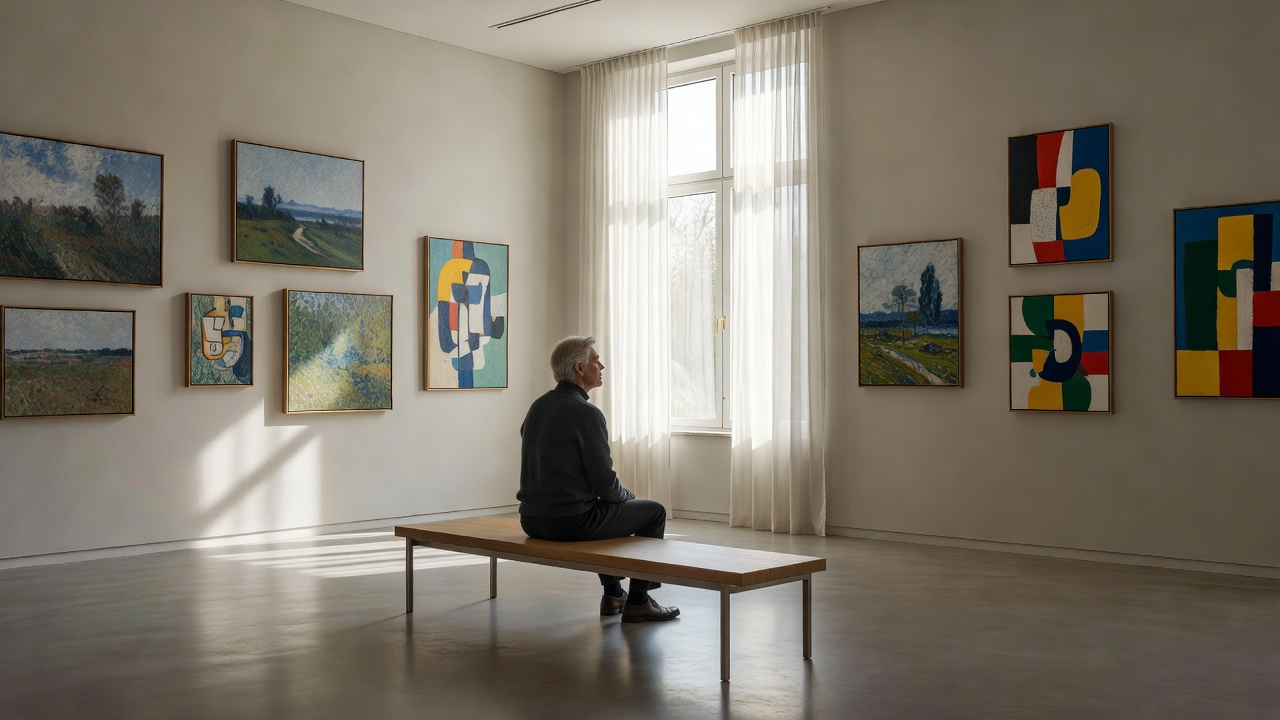
Draw the viewer as well as the work
Mark likely standing and seated positions on the plan. Add the arc of an opening door, the space occupied by a group and the route needed to move equipment safely. A nominally generous gallery can become awkward when every preferred viewing point sits inside its only circulation path. The solution may be a different hanging location rather than a larger room.
Do not treat viewing distance as a fixed ratio that applies to all art. Surface, scale, detail, framing and the artist’s installation instructions may each change the encounter. Provide opportunities to look from more than one distance, then test the intended arrangement with full-size paper outlines or temporary mock-ups. These tests cost less than discovering a conflict after finishes are complete.
Use intervals, not only objects
An empty wall is not necessarily unfinished. It can let the eye release one image before meeting another. Consider the difference between a collection experienced as a continuous visual field and one encountered in distinct episodes. Neither is automatically better; the important point is to make that choice deliberately rather than letting the available wall area decide it.
The Menil Collection in Houston and the Beyeler Foundation in Riehen are useful places to study the relationship between rooms, daylight and moments of rest. Look at what happens beside the works as well as directly in front of them. A view outside can offer relief, but a bright opening can also dominate adaptation and turn a neighbouring artwork into a darker rectangle.
Make access part of the rhythm
Comfort should not depend on a visitor being able to stand for a long time. Consider stable seating, varied eye levels and routes that do not require people to reverse through narrow spaces. Discuss applicable access requirements with the project architect; England’s Approved Document M and BS 8300 provide relevant reference points, but neither replaces a project-specific assessment.
Finally, walk the sequence with people who have not seen the drawings. Ask where they hesitate, what they notice first and where they would choose to sit. Do not explain the intended route beforehand. Their responses reveal whether the room offers genuine choices or merely looks calm on paper. Keep the resulting notes with the display plan so the next arrangement inherits the learning, not just the fixing positions.
Named institutions are independent references for further observation. This publication is not affiliated with them.